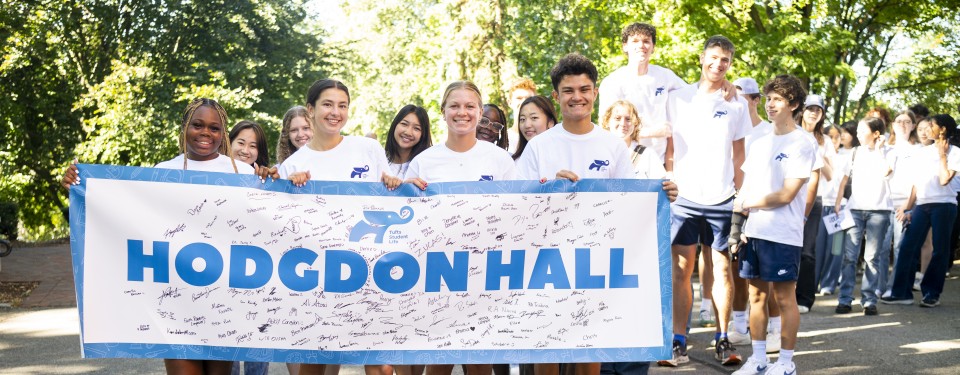
Jumbos come from a range of backgrounds and bring diverse talents, interests, and perspectives to the table; it almost makes more sense to talk about "diversities" rather than "diversity." While the collective energy of the Tufts community stems from the mix of people on campus, we also recognize how important it is for students to be able to connect with peers who share similar experiences and identities through affinity organizations and gathering spaces. Our community is supported by the Division of Student Diversity and Inclusion and the Office of the Vice Provost for Institutional Inclusive Excellence. Campus spaces include the Africana Center, Asian American Center, Center for STEM Diversity, FIRST Resource Center, Goddard Chapel, Granoff Family Hillel Center, Interfaith Center, International Center, Indigenous Center, Latinx Center, LGBT Center, Women's Center, and others. These centers not only provide dedicated physical spaces for socializing, student organization meetings, studying, and connecting with Center staff, but also provide sources of comfort and belonging.
Geographic Diversity
Tufts’ undergraduate students arrive on our campus from 50 states, the District of Columbia, Guam, Puerto Rico, the US Virgin Islands, and more than 100 countries – from Cape Cod to the Florida Keys, from Long Island to the Rio Grande Valley, from Brazil to Bangladesh. They come from small towns like Stuttgart, Arkansas and from the hearts of major cities like Shanghai, Mumbai, and NYC.
13 percent of Tufts students come from an international background. The International Center serves as an academic and social resource for international students, helping students maintain valid US immigration status and advising the I-Club, International House, and Global Orientation.
Racial and Ethnic Diversity
Nearly 50 percent of US undergraduate students identify as students of color. Many first-year students participate in peer leadership programs through the Africana Center, Asian American Center, Indigenous Center, and Latinx Center. Additionally, the Africana Center coordinates Students' Quest for Unity in the African Diaspora (SQUAD), an optional pre-orientation program for incoming students focused on Black perspectives and experiences. Sophomores, juniors, and seniors are welcome to explore special interest housing, including Capen House, La Casa Latinx, and Eurasian House.
Cultural organizations celebrate their identities through annual events such as the Black Showcase, Association of Latin American Students (ALAS) Culture Show, and Tufts Association of South Asians (TASA) Culture Show. These events highlight some of Tufts’ talented performance groups and allow them to share a piece of their cultures with the larger community. Student-run clubs and organizations on campus include the African Student Organization, Arab Students Association, Association of Multiracial People, Black Student Union, Cape Verdean Students Association, Caribbean Student Organization, Chinese Students Association, Filipinx Student Union, Indigenous Students’ Organization, Italian Club, Japanese Culture Club, Vietnamese Students Club – and the list goes on.
The Center for STEM Diversity provides advising and mentorship to promote success in STEM disciplines. The CSD offers a first-year advising seminar, supports students with accessing funded research opportunities, and advises student organizations such as the Society of Latinx Engineers & Scientists (SOLES) and National Society of Black Engineers (NSBE).
Coursework related to race and ethnicity can be found across numerous academic departments at Tufts, most notably in the Department of Studies in Race, Colonialism, and Diaspora, which facilitates several majors and minors in the disciplines of Africana Studies, American Studies, Asian American Studies, Colonialism Studies, Latinx Studies, and Native American and Indigenous Studies. Additionally, the Center for Public History (CPH) at Tufts serves as a space for research, events, and programs related to public discourse, cultural institutions, family history and place-based learning. The CPH's signature programs include the African American Trail Project, a public history archive of social change movements in Boston’s Black communities.
Socioeconomic Diversity
Since 1852, Tufts has been committed to the vision of its founders to educate all people, regardless of their socioeconomic background. 16 percent of our most recent entering class receive federal Pell Grants, funds offered to undergraduate students with exceptional financial need. In recent years, we have awarded more than $120 million in institutional grants to undergraduate students and Tufts proudly meets the full demonstrated need of all admitted students, regardless of citizenship status, for all four years.
First-Generation Students

Approximately 12 percent of Tufts students are among the first generation in their family to attend college. In 2019, Tufts was recognized among the first cohort of “First-Gen Forward institutions” by NASPA’s Center for First-Generation Student Success in acknowledgement of Tufts’ commitment to supporting first-generation student achievement. Our first-generation students build community through the FIRST Resource Center, the optional first-year advising seminar for first-generation students, and a pre-orientation program called Building Engagement and Access for Students at Tufts (BEAST).
Sexuality and Gender Diversity
We are proud that women take especially strong roles in the sciences and engineering at Tufts. 46 percent of undergraduates in the School of Engineering are women and the percentage of female Engineering faculty is nearly ten percent above the national average. The Women's Center is a space open to all students interested in issues broadly related to the experiences of women, the impacts of sexism and misogyny, and the role of gender in our lives. In the School of Arts and Sciences, Tufts’ Women’s, Gender, and Sexuality Studies major is available to students interested in an interdisciplinary approach to analyzing the various historical and political circumstances, social and economic forces, and cultural representations that shape gendered lives.
Tufts' LGBT Center offers a space for all students to explore their unique relationship to gender and sexuality through personal, activist, and/or academic lenses. The LGBT Center provides programming, support, and personal and educational resources that aim to affirm the experience of LGBTQIA+ people at Tufts. Tufts boasts a number of LGBT student organizations (like the Queer Desis), a first-year peer leader program, weekly discussion groups, and an LGBTQ-themed housing unit. Along with the LGBT Center, these groups sponsor speakers, movie nights, and other social and educational events for LGBTQ students and allies. Tufts has an open housing policy, which means we don’t use gender as a determining factor for housing arrangements, and students are free to create living situations that work for them. Tufts’ student medical insurance plan covers a range of gender-affirming health services to support students’ well-being and gender identity. The greater Boston area is particularly welcoming to its large number of LGBT students and Massachusetts is famous for being the first state to legalize same-sex marriage and for having some of the strongest anti-discrimination statutes in the country.
Religious and Spiritual Diversity
Supported by the University Chaplaincy, Tufts students represent a range of faith traditions and spiritual practices—our campus is home to Christians and Jews, Muslims and Buddhists, Hindus and Sikhs, atheists and agnostics, humanists and nonreligious students. On campus, you’ll find weekly Buddhist, Jewish (Reform and Conservative), Hindu, Muslim, Protestant, and Catholic gatherings and services. The Granoff Family Hillel Center is an active gathering space to explore Jewish identity, observe holidays, and develop educational initiatives. Off campus, the Medford/Somerville area is home to a number of religious communities.
Religious student groups include Buddhist Mindfulness Sangha, Catholic Community at Tufts, Chabad, Hillel, Hindu Students Association, Humanist Community at Tufts, Muslim Students Association, Orthodox Christian Fellowship, Protestant Students Association, among others. There is also an active interfaith student organization.
Tufts faculty in the Department of Religion are specialists and researchers in Buddhism, Hinduism, Jainism, Christianity, Islam, and African Diasporic religions. The Judaic Studies major and minor combine the study of the Hebrew language and the religious texts and practices, culture, and history of the Jewish people.
Ideological and Political Diversity
Tufts is deeply committed to civic engagement and seeks to prepare students to be lifelong active citizens of the world. With this goal in mind, we welcome students with a variety of political values and perspectives and seek to facilitate productive dialogue across ideologies. Tufts students develop their civic skills through the pre-orientation program Students Heightening Actionable Political Engagement (SHAPE), through special academic opportunities like the Center for Expanding Viewpoints in Higher Education and Education for Public Inquiry and International Citizenship (EPIIC), and through research endeavors like Center for Information and Research on Civic Learning & Engagement (CIRCLE).
Some students are involved with partisan organizations such as Tufts Democrats, Tufts Federalist Society, Tufts Republicans, and Young Democratic Socialists of America, while others contribute to student organizations that promote broad political participation, such as Advancing Civic Thought in Our Nation (ACTION). Additionally, Cooperation and Innovation in Citizenship (CIVIC) is a non-partisan organization that sponsors events and political discussions focused on meaningful discourse, respectful disagreement, and the development of friendships with those across the political spectrum. Alliance Linking Leaders in Education and the Services (ALLIES) is a student organization engaged in weekly discussions and annual research projects related to foreign policy, security, and civilian-military cooperation. Through courses and speakers series hosted by the Jonathan M. Tisch College of Civic Life, Department of Political Science, and Fletcher School of Law and Diplomacy, students learn from and alongside elected officials, political appointees, lobbyists, and scholars reflecting a diversity of positions and beliefs.
Students with Disabilities or Chronic Illness
The Tufts community values the lived experiences and voices of people of all abilities, including students with disabilities or chronic illness. There are many resources available to members of our community that strive to make Tufts accessible to all.
A terrific campus partner is the Student Accessibility and Academic Resource (StAAR) Center, which fosters students' educational growth and awareness; self-advocacy and resilience through support services including academic, housing, and dining-related accommodations; transportation accommodations (including accessing Lyft rides as needed); academic tutoring; and assistive technology. The StAAR Center also hosts a variety of trainings and workshops for the campus community, valuing the diverse educational and cultural experiences of every student and promoting access to an inclusive and collaborative learning environment
Access Betters the Lives of Everyone (ABLE) is a student group focused on connecting students with disabilities to form a mutually supportive community, to advocate for disability rights on campus and beyond, and to educate the Tufts community about disabilities.
To support faculty and staff, the Office of Equal Opportunity is committed to providing reasonable accommodations to qualified individuals with disabilities in a fair and equitable manner and in accordance with applicable federal and state law, including the Americans with Disabilities Act (ADA).