
Civil Engineering
Available Major
Available Major
Civil engineering is one of the most diverse engineering disciplines. Civil engineers are responsible for the planning, design, construction, and operation of the physical structures and facilities essential to the infrastructure of modern society: buildings, highways, water and waste treatment plants, tunnels, airports, harbors, and bridges. The civil engineer is also involved in research and development in a wide variety of physical and natural systems. These include the rebuilding of the nation’s infrastructure and forecasting the impact of human activity on the environment with the use of mathematical models.
At Tufts, civil engineering is strongly allied with environmental engineering into a single program with four areas of specialization: environmental engineering, geotechnical engineering, structural engineering, or water resources engineering.
Environmental engineers create systems that protect the air, land, and water while still serving vital societal needs. Geotechnical engineers study the response of soil and rock to loads, environmental contaminants and geohazards, and design structures such as foundations for bridges and buildings, tunnels, and containment structures for hazardous waste sites. Structural engineers focus on construction of buildings, towers, dams – essentially anything that needs a skeleton. Water resource engineers focus on the wide range of issues involving water – preservation and restoration of rivers and watersheds, groundwater contamination and abatement, and more. The degree prepares students to enter professional careers or continue with further academic study.
The BS in Civil Engineering (BSCE) program is accredited by the Engineering Accreditation Commission of ABET, https://www.abet.org, under the General Criteria and Program Criteria for Civil and Similarly Named Engineering Programs.
Sample Classes:
Photo credit: Alonso Nichols/Tufts University from Photoshelter
A timelapse look as Tufts Engineering Steel Bridge Team members go through their final practice run before the ASCE Conference competition.
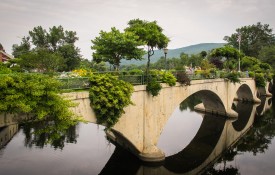
The Bridge of Flowers in western Massachusetts proves a creative case study for Tufts engineering students
Read More